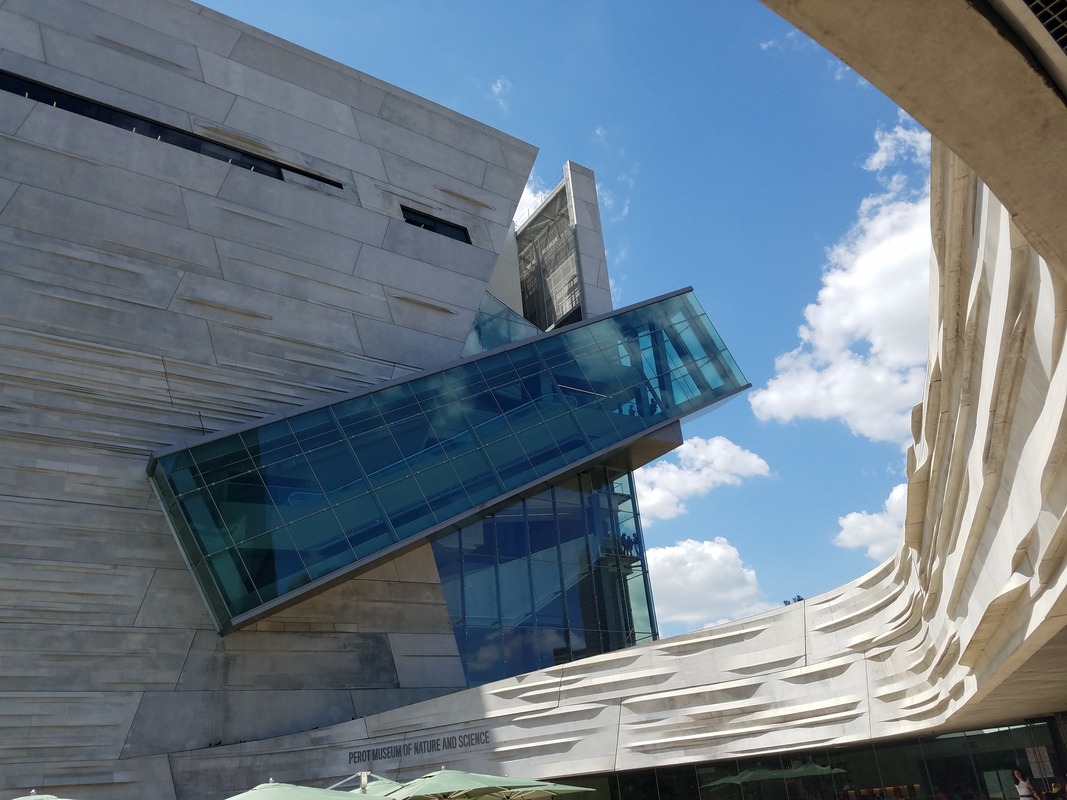
The exterior draws inspiration from sedimentary geological formations, translating the movement of the Texas landscape into a highly articulated facade. Realizing this vision required Wells to challenge nearly five decades of established fabrication practices. For the cube, the team developed a modular system using interchangeable components that maximized variability within a highly systematic manufacturing process. The plinth and atrium demanded a more bespoke approach, with many forms used only once. One of the most complex elements was a transitional panel at Level 3, where opposing geometries create the appearance of a twisted form while remaining horizontally true. A large-scale mockup ultimately provided the architect, contractor, and owner with a clear understanding of what had been achieved. As Morphosis’ Arne Emerson noted, “They definitely wanted to see something tangible that they could look at and say, ‘this is it.’ …this is absolutely amazing.”
Precision in documentation became essential. At the time, Building Information Modeling (BIM) was still emerging within construction and manufacturing, yet it proved critical to the project’s success. The work was divided into three BIM models — the cube, atrium, and plinth — to support efficient manufacturing and coordination. The cube delivered the majority of the building’s square footage and achieved high efficiency through the modular forming approach, while the atrium and plinth introduced greater complexity due to inconsistent angles and multiple radius points. Within the atrium alone, more than 100 panels measuring 10 ft by 10 ft required advanced coordination. BIM also enabled the development of new connection strategies to support the facade’s free-flowing geometry and floor separations of up to 35 ft. As Russ Vines explained, “The challenge was to find a column layout that would efficiently support a grid of precast panels with the consideration of atypical window sizes, window locations and the panels’ ability to perform under wind loads. The result was basically a choice of two HSS columns per an arrangement of vertical panels that could loosely be referred to as a bay.”
The Perot Museum of Nature and Science remains one of Wells’ most influential projects, establishing a design-assist approach and modular forming strategies that continue to inform how we work today. It reflects the dual responsibility of museum architecture: preserving collections while creating an inspiring, educational, and safe environment for residents and visitors. More broadly, the project reinforced how prefabricated concrete can deliver long-term resilience, disciplined collaboration, and timeless facades designed to perform for generations.